
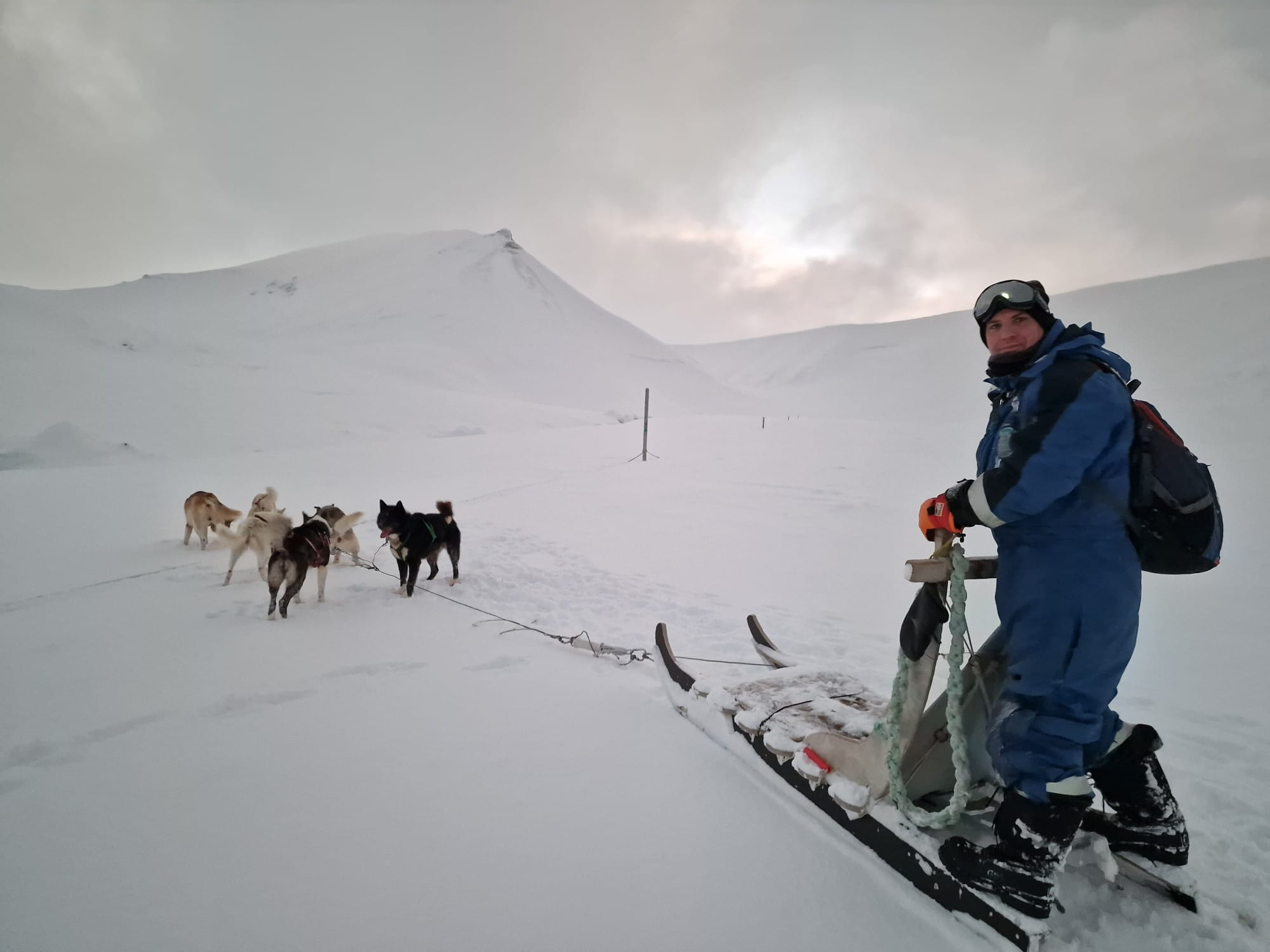
I recently travelled to Svalbard, which is located deep in the Arctic Circle. Winter there feels stark and elemental. The light is sharp, the air burns your face, and the landscape seems stripped down to the essentials of survival. Even in Svalbard’s main town of Longyearbryn, you feel like you are at the edge of the world.
I went to experience husky sledding – a lifelong dream to experience these dogs doing what they were bred to do. But, as often happens when you spend time around animals, I found myself observing something else as much as the dogs themselves: the relationship between humans and animals when they are placed together in an extreme environment.
One of the first places I visited was a husky café – Café Huskies, in Longyearbryn.
It was immediately clear that the dogs brought people enormous joy. Visitors would walk in, see the huskies, and instinctively want to greet them. Smiles appeared, voices lifted with excitement, and hands reached out to touch fur. From a behavioural perspective it seemed very likely that oxytocin was playing a role. Humans are biologically wired to feel pleasure and comfort through physical contact with animals, and each other, and dogs are one of the most powerful triggers of that response.
But alongside the joy there was a more complicated dynamic.
Some visitors struggled to recognise the dogs as individuals with their own needs and boundaries. A few people tried to force affection on the dogs, treating them more like a tourist attraction than a living animal.
One older husky had clearly learned how to manage this situation. When he wanted space, he simply removed himself. When he did want contact, he would sit quietly with his back to a person so they could stroke him calmly. It was a remarkably clear example of a dog setting his own boundaries.
A younger dog, around seventeen months old, struggled more with the environment. When the café became crowded and noisy he became jumpy and started play-biting. From a behavioural standpoint this looked less like misbehaviour and more like a young dog whose excitement and arousal had exceeded his ability to regulate himself.
The children created another interesting dynamic.
When children became overexcited, the younger dogs often mirrored that energy. The cycle could escalate quickly: a child would become louder and more animated, the dog’s arousal would increase in response, and the interaction would suddenly tip from playful to overwhelming. In several cases the child then became frightened when the dog’s behaviour intensified.
Parents usually stepped in eventually, but often later than was ideal.
It was a small but clear reminder of how strongly human behaviour shapes canine behaviour, even in brief encounters.
The most striking contrast came later when I went sledding with the working dogs.
Before the run the dogs were chaos. They howled, barked, jumped, and pulled against their harnesses with incredible intensity. The sound was constant and the energy felt explosive.
But the moment the sleds were released and the dogs began to run, everything changed. The noise disappeared almost instantly.
The dogs settled into a steady rhythm, pulling the sled across the snow with complete focus. What had looked like frantic chaos only minutes earlier resolved into calm, purposeful movement. It was a powerful illustration of what happens when a dog is allowed to do the work it was bred for. The excitement beforehand was not anxiety. It was anticipation. Once the dogs had purpose, their behaviour regulated itself.
Outside of the sled dogs, the wildlife offered another small insight into behaviour.
During a snowcat journey we encountered several reindeer. What was striking was how little fear they showed toward humans or vehicles. They watched us with curiosity rather than alarm.
Later I learned that reindeer in Svalbard have no natural predators on the islands. Without the evolutionary pressure of being hunted, their behaviour has adapted accordingly. It was a simple but powerful demonstration of how ecology shapes behaviour.
What stayed with me most from Svalbard was the contrast between two different kinds of human–animal interaction.
In the café, the dogs were part of a human leisure environment. The joy people experienced when meeting them was genuine, but the dogs had to navigate a constant stream of unpredictable human behaviour.
On the sled, the relationship was very different. The dogs were not an attraction. They were working partners, engaged in the task they were bred to perform.
Seeing both environments side by side reinforced something fundamental about dogs.
Dogs cope best when their behaviour has purpose, when their emotional signals are respected, and when humans recognise that they are not just companions, but animals with their own needs, limits, and instincts.
In the Arctic landscape, where life is defined by function and survival, that lesson felt particularly clear.